


 By
By Traffic Sources for Affiliate Marketing: The Complete Guide (2026)
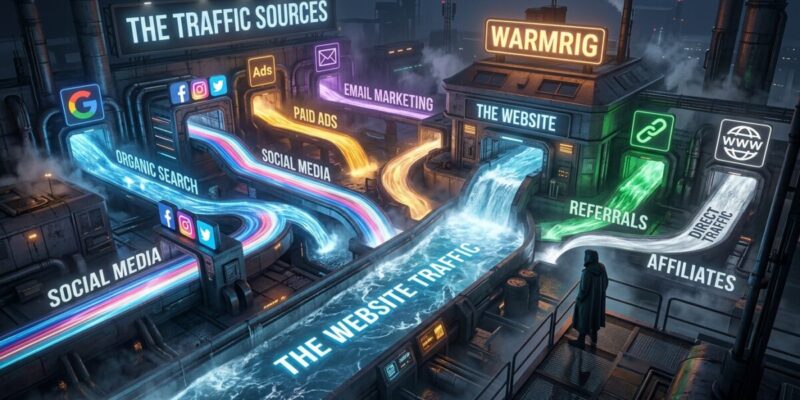
Affiliate marketing is simple in theory: buy traffic for less than you earn from the offers it converts. The hard part is the traffic — where to get it, which format fits your offer, and how to buy it without lighting money on fire. This guide breaks down the traffic sources that actually matter in 2026: the ad formats, the tiers and verticals, how to choose a network, and how it all connects to the tracker and account stack behind a profitable campaign.
(You’ll need a tracker to measure any of this — see what an ad tracker is.)
What a “traffic source” is
A traffic source (or ad network) is a platform where you buy visitors and send them to your offer or landing page. Instead of waiting for organic traffic, you pay to put your ad in front of an audience — by click (CPC), by thousand impressions (CPM), or by conversion goal (CPA). The network aggregates ad space (or subscribed users) across thousands of publishers and sites, and gives you targeting and optimization tools to reach the right people.
For affiliates, the network you choose shapes everything: the format your ad takes, the geos and verticals that work, the quality of the traffic, and your cost per conversion.
The main ad formats
Most affiliate traffic comes in a handful of formats. Match the format to your offer:
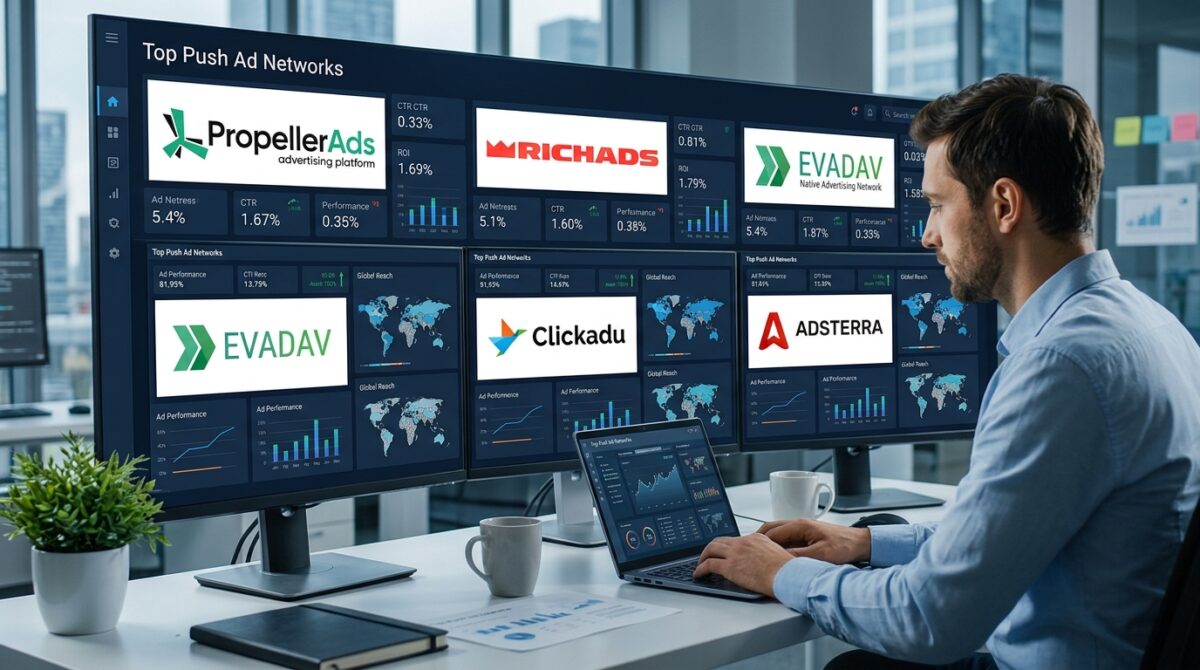
Push notifications. Messages delivered to users who subscribed to a site’s notifications — they appear like system alerts on the device, so they’re highly visible, and users don’t need to be browsing at the time. Cheap CPC, huge volume, great for utilities, gambling, dating, and sweepstakes. A workhorse format. (See our best push ad networks guide.)
In-page push. Push-style ads shown inside a webpage rather than as a system notification — which means they work on iOS (no subscription needed) and face easier moderation. It’s grown from a bonus format into a primary traffic source for many affiliates.
Popunder (pop). A full-page ad that opens behind the browser window. Massive volume, very cheap CPM, and aggressive — good for high-volume testing and verticals where a big, unmissable placement converts. Quality varies, so tight targeting and source filtering matter.
Native. Ads that blend into the look of the content around them (think recommended-article widgets from Taboola, Outbrain, or MGID). Higher quality and less intrusive, better for content-style funnels, ecommerce, and warmer audiences — at a higher cost.
Interstitial / display / banner. Full-screen transitions, and classic banners — supplementary formats for specific placements and retargeting.
Tiers and verticals
Two concepts shape where and what you run:
Geo tiers. Tier 1 (US, UK, Canada, Australia, Western Europe) has the highest payouts but the most competition and cost. Tier 2 and Tier 3 (much of Asia, Africa, Latin America, Eastern Europe) are cheaper and easier to profit on while you learn, with lower payouts. Beginners often start in Tier 2/3 to test cheaply, then move to Tier 1 with what works.
Verticals. The offer categories that dominate paid affiliate traffic: iGaming (gambling/betting), dating, sweepstakes, finance/crypto, nutra, utilities/software, and mobile subscriptions. Each pairs better with certain formats and geos — push and pop suit gambling/dating/sweeps; native suits finance and ecommerce. The network’s strengths should match your vertical.
How to choose a traffic source
The criteria that decide a good network for affiliates:
- Traffic volume and geo coverage — enough inventory in the countries you target.
- Minimum CPC/CPM and deposit — how cheaply you can test, and the entry cost.
- Targeting depth — country, device, OS, browser, carrier/ISP, connection type, time, frequency capping.
- Optimization tools — smart bidding (CPA Goal), micro-bidding down to the source, whitelist/blacklist filtering.
- Anti-fraud — real, engaged audiences rather than bot traffic.
- Format fit — the network should be strong in the format your offer needs.
- Support and moderation speed — fast ad approval and responsive managers matter when you’re scaling.
See our best ad networks guide for the top all-rounders and best push ad networks for the workhorse format.
How it connects to the rest of the stack
Buying traffic is one piece. To run it profitably you also need:
- A tracker to attribute every click and conversion by source and creative, so you scale winners and cut losers — see what an ad tracker is.
- Landing pages that pre-sell the offer and route by geo/device.
- For some models (managing many ad accounts on Meta/Google/TikTok), the multi-accounting stack — antidetect browser and proxies — to run and protect those accounts.
Traffic without tracking is guessing; tracking without good traffic is measuring nothing. You need both.
FAQ
What is the best traffic source for affiliate marketing? It depends on your offer and vertical. Push and popunder networks (RichAds, PropellerAds, Adsterra) are the cheap, high-volume workhorses for gambling/dating/sweeps; native networks (Taboola, Outbrain, MGID) suit content and ecommerce funnels. See our best ad networks guide.
What ad format should a beginner start with? Push and in-page push are beginner-friendly: cheap CPC, huge volume, easy moderation, and in-page push even works on iOS. Popunder is another cheap high-volume option for testing.
What are geo tiers? Tier 1 (US/UK/CA/AU/Western Europe) has the highest payouts and most competition; Tier 2/3 are cheaper and easier to profit on. Beginners often test in Tier 2/3, then scale winners to Tier 1.
How much do I need to start buying traffic? Most self-serve networks have low minimum deposits (often around $100) and low minimum bids (push CPC from fractions of a cent), so you can test small — but budget enough to gather real data before judging a campaign.
Do I need a tracker to buy traffic? Yes — without one you can’t tell which source, creative, or placement makes money, so you optimize blind. Pair any traffic source with a tracker.
Bottom line
Traffic is the engine of affiliate marketing, and choosing the right source means matching format (push, in-page push, pop, native) and network strengths to your offer, vertical, and geo. Start cheap in Tier 2/3 with push or pop to learn, scale winners to Tier 1, and always pair your traffic with a tracker to know what’s working. Begin with our best ad networks guide to pick a platform, and best push ad networks for the workhorse format.
Written for WarmRig — tested tools and infrastructure for traffic arbitrage and performance marketing. Independent, not sponsored.
















[…] Traffic Sources for Affiliate Marketing: The Complete Guide (2026) […]
[…] Traffic Sources for Affiliate Marketing: The Complete Guide (2026) […]
[…] Traffic Sources for Affiliate Marketing: The Complete Guide (2026) […]
[…] […]
[…] […]