



 By
By Wise Business Review 2026: The Multi-Currency Account
Getting paid is the unglamorous half of paid traffic. Networks settle in different currencies on different rails, clients want to pay by local transfer, and the moment a decent sum lands, a traditional bank starts asking questions. Wise Business is one of the most established tools for smoothing that out: a multi-currency account with local details in USD, GBP, EUR and more, mid-market exchange rates, and a Visa card — under one login and one IBAN.
Most reviews aim this at freelancers and small exporters. This one looks at Wise Business the way it actually gets used in performance marketing — as a payout hub and fiat backbone — and it’s honest about the one thing that matters most for this audience: how aggressively Wise polices accounts, and what that means when your inbound payments look nothing like a payroll run.
Disclaimer: Independent, informational review — not financial, tax, or legal advice. Wise is not a bank. Balances are safeguarded, not deposit-insured (no FDIC in the US, not FSCS-protected as deposits in the UK). Pricing changed in November 2025 and keeps evolving — always confirm current terms at wise.com/business before acting.
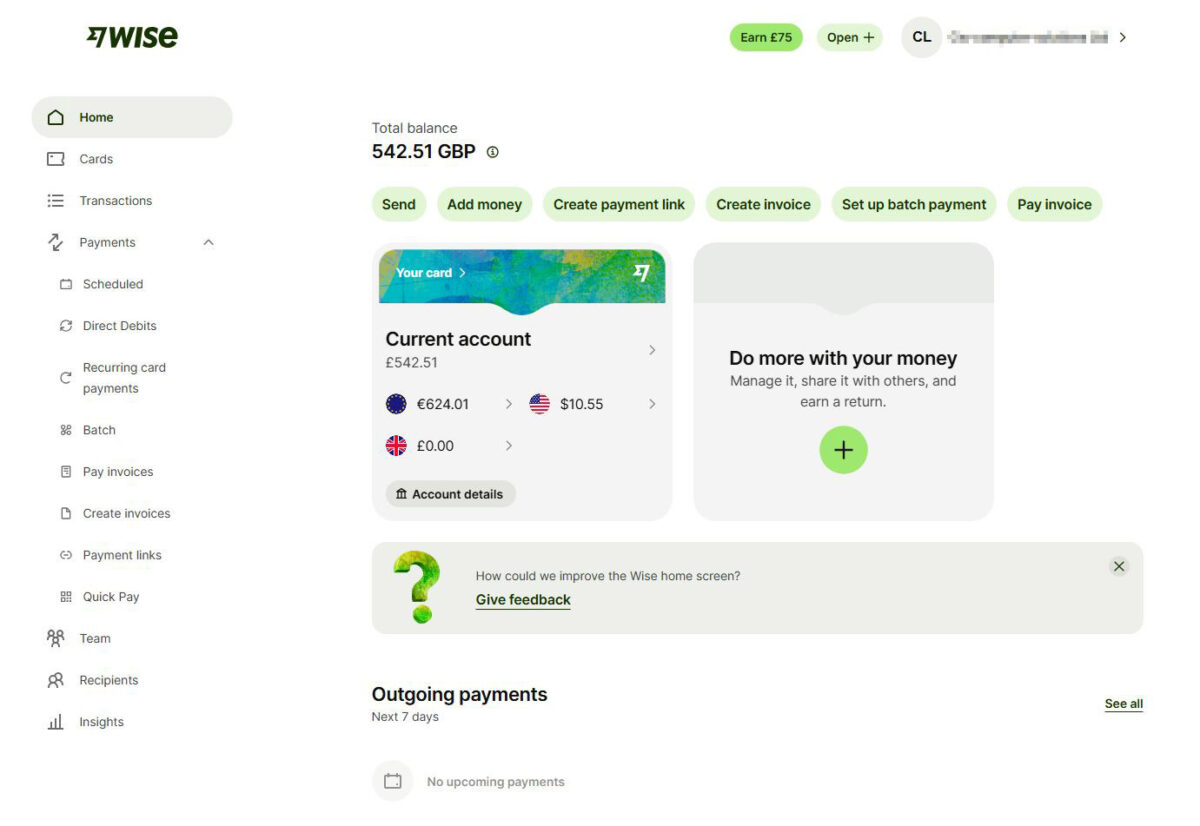
The Wise Business dashboard — total balance, quick actions
Quick verdict
Wise Business is the best fiat money-movement account most media buyers can open: cheap transparent FX, genuine multi-currency receiving, strong app, and a track record millions of businesses trust. Its weakness isn’t the product — it’s the risk posture. Wise runs strict anti-money-laundering controls and is known to freeze or review accounts whose activity looks irregular, which is a normal week for an affiliate. Use it as a primary fiat account and payout hub, keep clean records, and never warehouse your whole float here. For crypto rails and stablecoin yield, pair it with something like KAST — Wise doesn’t do that side.
| What it is | Multi-currency fintech account (not a bank), live since 2011 |
| Company | Wise plc — London-founded, listed on Nasdaq/LSE, 16M+ customers |
| Opening cost | One-off ~$31 USD / ~£50 GBP (region-dependent); no monthly fee, no minimum |
| Currencies | Hold 40+; local receiving details in USD, GBP, EUR, AUD and more |
| FX | Mid-market rate + fee from 0.33% (e.g. GBP→EUR ~0.37%) |
| Card | Wise Visa debit + expense cards (availability varies by country) |
| App rating | ~4.8 Google Play (~2M ratings), ~4.3 Trustpilot (~294K reviews) |
| The catch | Strict AML — account reviews and freezes are a real, recurring risk |
What Wise Business actually is
Wise Business is a multi-currency account, not a full business bank account. It’s built by Wise plc (formerly TransferWise), a London-founded fintech that launched in 2011, is now dual-listed on Nasdaq and the LSE, and serves over 16 million customers. In the UK it’s regulated by the FCA; in the US it’s registered with FinCEN and operates under state money-transmitter licences. That regulatory footprint is real, but it is not a banking charter — a distinction that became very public in July 2026, covered in the safety section below.
The core mechanic is simple and it’s the reason to open one: you get local account details in multiple currencies at once — a US routing/account number, a UK sort code and account number, a euro IBAN, and others — so clients and networks can pay you by cheap local transfer instead of expensive international wire. Money lands in whatever currency it was sent, you hold it, and you convert at the mid-market rate only when you choose to.
Why it matters for affiliates and media buyers
Strip away the “small exporter” framing and here’s the performance-marketing version.
One account, every payout rail (in fiat). CPA and affiliate networks that pay by wire will happily send to a local USD or EUR account. Instead of a patchwork of accounts, you hand each network the local details that fit their system, and everything consolidates under one login.
Cheap, honest currency conversion. Get paid in USD, pay a European tool in EUR, settle with a contractor in GBP — Wise converts at the real mid-market rate with the fee shown upfront (from 0.33%), which is dramatically cheaper than the 2–4% hidden spread a bank or PayPal buries in the exchange rate.
Pay your team and suppliers in bulk. If you run creators, media buyers, or VAs, Wise’s batch payments let you upload a CSV of up to 1,000 recipients and pay them in one action — payroll-style, across currencies.
A card for the tools you already buy. The Wise Visa pulls from your currency balances for antidetect subscriptions, proxies, hosting, and SaaS, with expense cards and limits you can issue to team members.
The honest fit: Wise is where fiat money arrives, gets held cheaply, and gets paid out — provided your activity stays inside its acceptable-use lines.
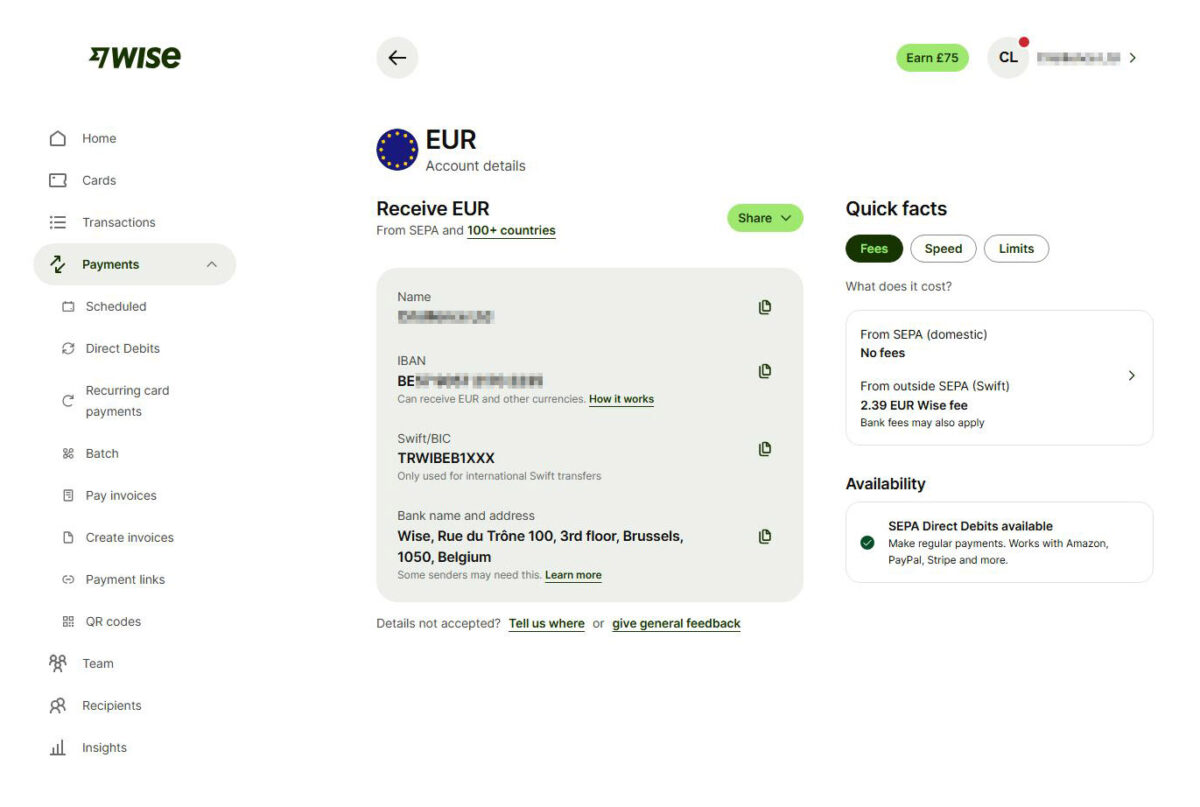
Wise Business local EUR details (IBAN/BIC)
Receiving payouts: the core use case
This is the setup worth getting right, because it’s the whole reason to open the account.
USD (for US networks and clients). After verification you get US ACH account and routing numbers. To a US payer it looks like an ordinary domestic transfer — no international wire, no wire fee on their end.
EUR (for European networks and clients). You also get a euro IBAN for SEPA transfers, which for many senders arrive same or next business day, or in seconds where SEPA Instant is supported.
GBP and others. UK sort code and account number, plus local details in other supported currencies — receiving from 30-plus countries into 8-plus currencies, depending on your registration country.
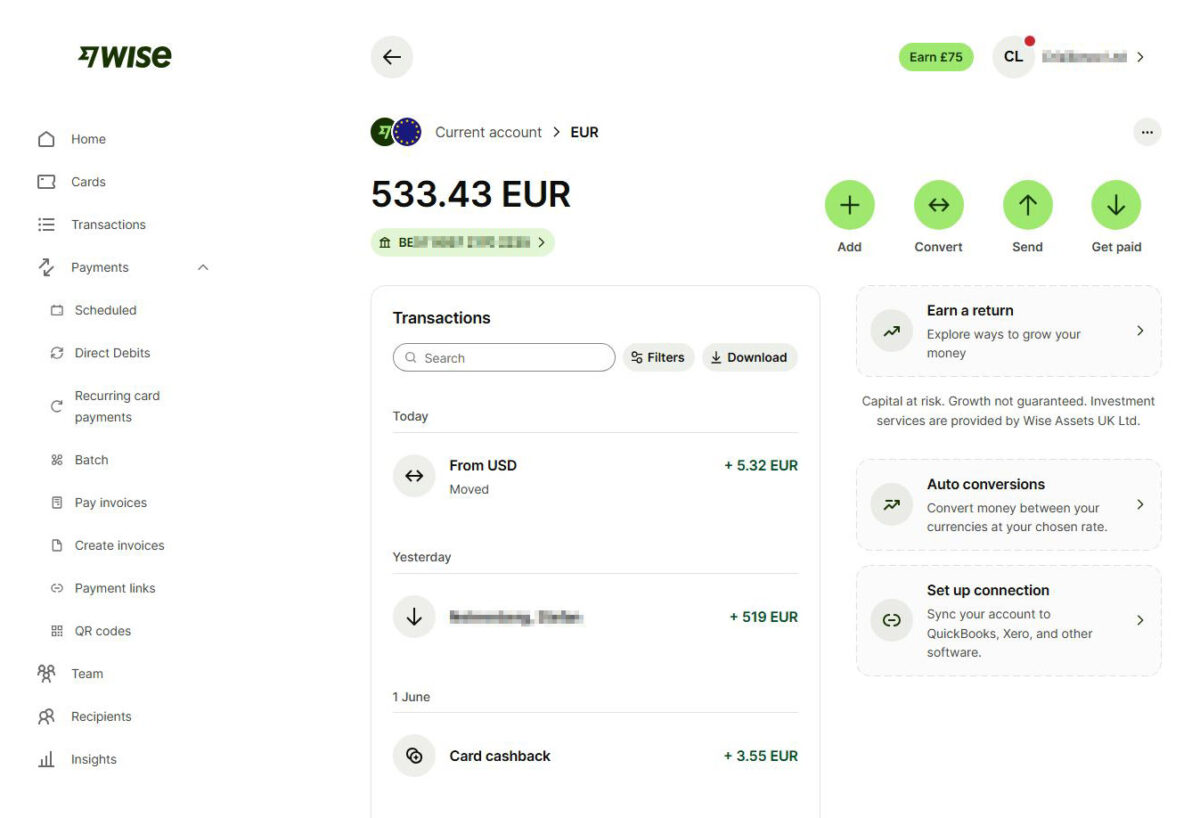
Wise Business – Inside a currency balance
The win is the same as with any good payout hub: one KYC, one dashboard, several local rails, instead of juggling separate accounts per payout method. Note that available currencies and card access depend on where your business is registered — most businesses in the UK, US, EEA, Australia, New Zealand, Japan and Singapore get the full feature set; several other regions get accounts without a card. Check Wise’s availability page for your country before you rely on a specific feature.
The card, the FX, and the real costs
Wise’s pricing is genuinely one of the most transparent in the category, and it’s a pay-as-you-go model — no monthly subscription, no minimum balance.
Opening cost. A one-off fee to unlock the full business account — roughly $31 in the US, about £50 in the UK — charged after approval, not during the application. Since the November 2025 pricing change, Wise offers a free entry tier and a one-off paid tier that unlocks receiving incoming payments and direct debits; exact names and prices vary by region, so confirm yours at wise.com/business.
FX fee. Every conversion uses the mid-market rate plus a declared fee starting from 0.33% and varying by currency pair (GBP→EUR sat around 0.37% in early 2026). This is the number that makes Wise cheap: the rate you see is the real rate, with the fee itemised, not hidden in a marked-up spread.
Card spend. The Wise Visa spends from whichever currency balance matches, converting at mid-market when it doesn’t. For a business buying tools priced in several currencies, that’s meaningfully cheaper than a home-currency card eating an FX margin on every charge.
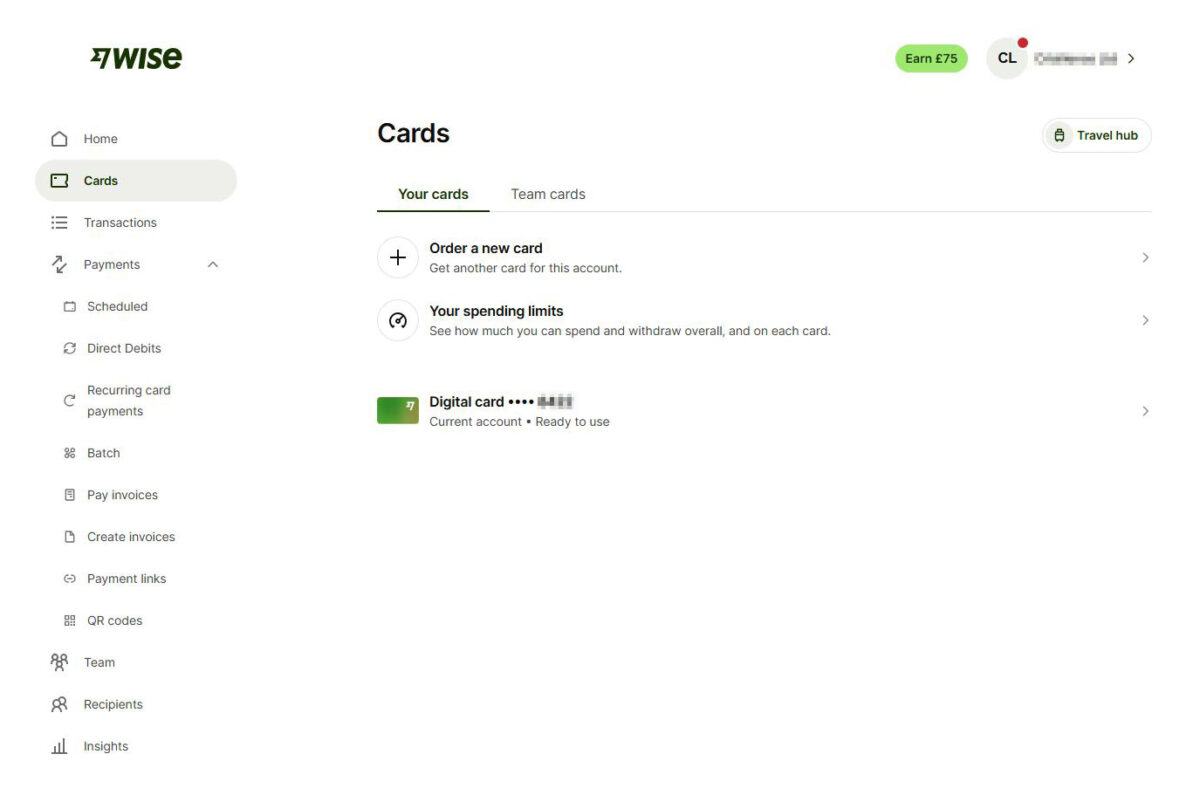
Wise Business – the Cards section
For a media buyer, the takeaway: Wise is optimised for cost transparency and multi-currency, not rewards. There’s no headline cashback like a stablecoin card — the value is in what you don’t lose to spreads and wire fees.
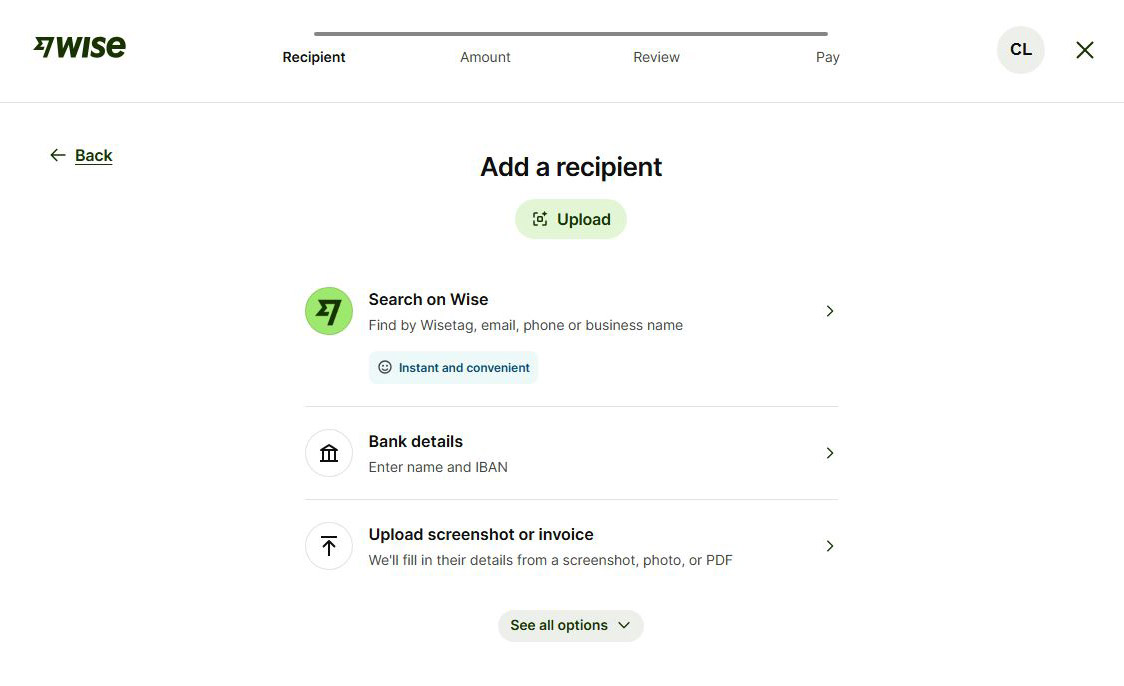
Wise Business – sending a payment
Business features worth the setup
These are the pieces the personal account doesn’t have, and they’re what justify the business tier:
- Batch payments (BatchTransfer) — pay up to 1,000 recipients from one CSV upload; the practical tool for paying a team of buyers or creators.
- Multi-user access — role-based team logins (viewer, and higher permission levels) so a partner or accountant can operate without sharing your credentials.
- Expense cards — issue Wise cards to team members with spending limits and controls.
- Invoicing tools — create and send invoices in the currencies you bill in.
- Accounting integrations — sync transactions automatically to QuickBooks or Xero.
- Marketplace/platform payouts — pull earnings in from Stripe, Shopify, Amazon and similar directly to your Wise balance.
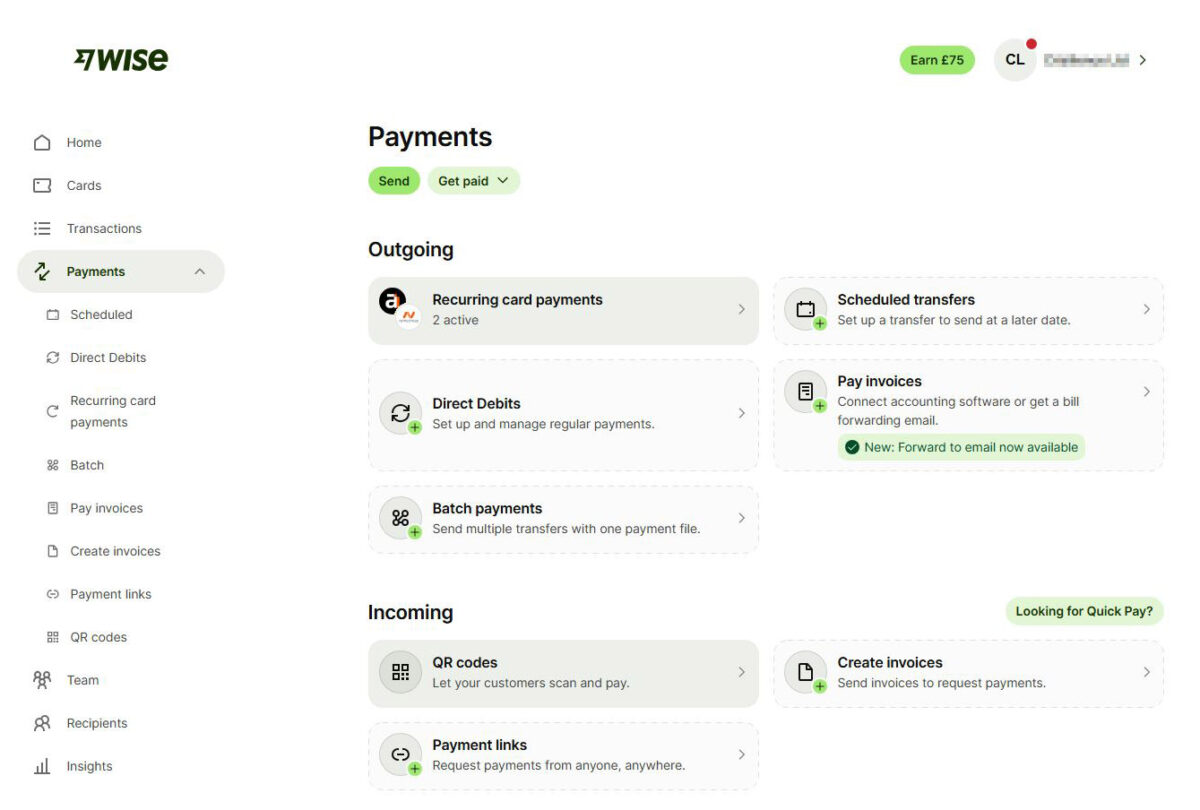
Wise Business – the Payments hub gathers it all
Plans and pricing: the honest math
Because there’s no monthly fee, the “which plan” decision is low-stakes compared with a subscription account: you pay a small one-off to open, then per-use FX and transfer fees. The lever that matters is the FX fee on the volume you actually convert, not the tier name.
The sensible sequence: open the free entry tier first, and only pay the one-off upgrade when you’re ready to receive payments and use the full feature set. That gives you a look at the account before committing a cent — a nice change from tools that charge before you’ve tested anything. For most people the full business account pays for itself the first time you receive an international payment at mid-market instead of losing a bank’s FX margin on it.
Fees at a glance
| Action | Cost |
|---|---|
| Open account | One-off ~$31 USD / ~£50 GBP (region-dependent) |
| Monthly fee | None |
| Minimum balance | None |
| Receive via local details (USD/GBP/EUR) | Free to low, depending on currency/plan |
| Currency conversion | Mid-market rate + fee from 0.33% |
| Send international payment | Varies by destination; shown upfront before you confirm |
| Card spend (matching currency) | No FX; conversion at mid-market when currencies differ |
The pattern: Wise is cheap and transparent on receiving and converting, with the real cost visible before every action. There’s no spread to reverse-engineer.
KYC, AML, and keeping your account alive
This section matters more for you than for a typical small business, so read it twice.
Wise verifies with photo ID, proof of address, and — for companies — your registration number and director details, then runs automated checks. Straightforward businesses clear quickly; complex ownership takes longer. So far, normal.
The part to plan around: Wise runs strict, active AML monitoring, and it freezes or reviews accounts whose activity looks irregular. Large sums arriving from many different sources, sudden volume spikes, and funds touching crypto or high-risk counterparties are exactly the patterns its systems flag — and exactly what an affiliate’s inbound looks like. Wise account holds are one of the most common complaints in its reviews, and support is chat-and-email only, with no phone line, so an urgent hold can be slow to resolve.
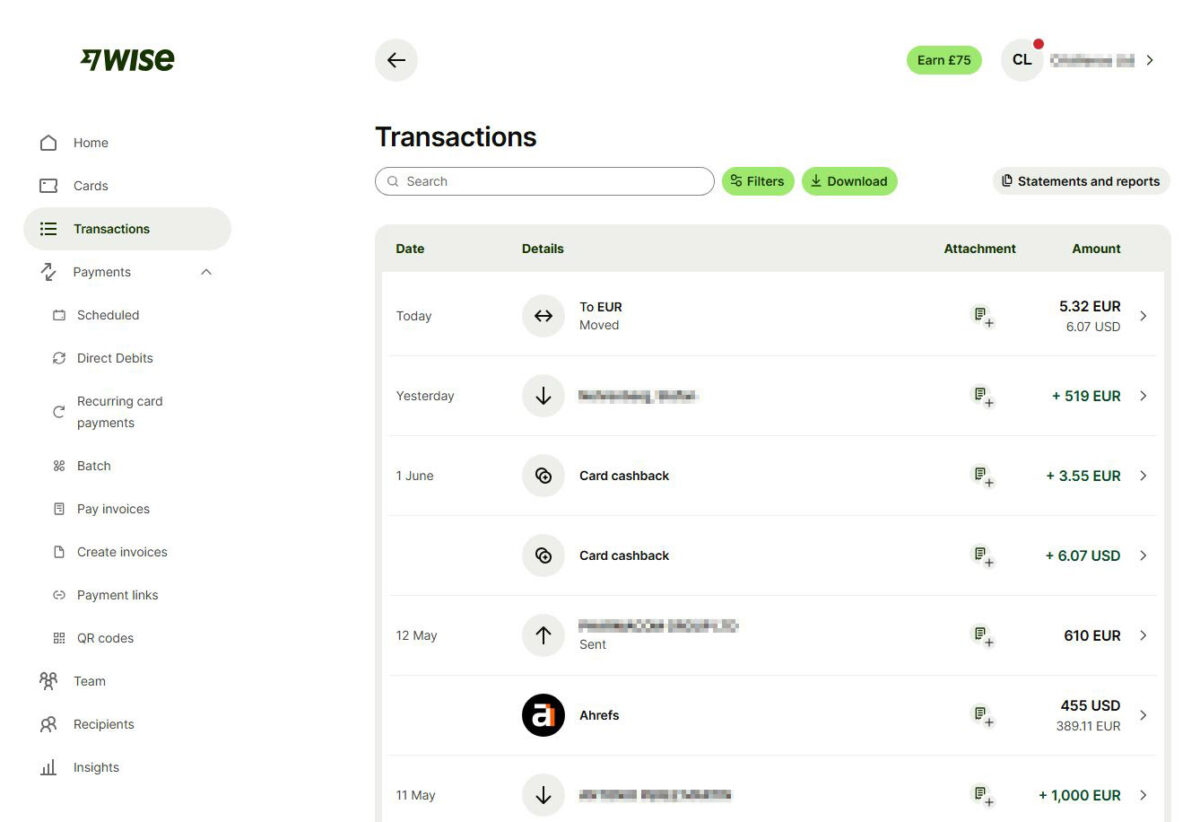
Wise Business full transaction history with filters and export
Protect yourself the boring, effective way:
- Keep invoices and network statements for every payout from day one, so a source-of-funds request is a two-minute reply, not a scramble.
- Respond to compliance requests fast and honestly — ignoring one is how accounts get frozen; misrepresenting activity is how they get closed.
- Read the acceptable-use terms before you route grey-area flows through it. Wise restricts certain business types and high-risk activity, and if your model lives in that zone, Wise may not be the right primary account.
- Because it isn’t a bank and balances aren’t deposit-insured, don’t warehouse your float here — keep working balances in Wise and move reserves to a bank or cold storage.
Is Wise a bank? Is it safe?
Short answer: safe as a well-run, heavily used fintech — but it is not a bank, and that isn’t a technicality.
In July 2026, the US Office of the Comptroller of the Currency rejected Wise’s application for a national trust bank charter, citing longstanding deficiencies in its US anti-money-laundering and counter-terrorist-financing controls and a management team it judged short on banking and fiduciary experience. Wise’s shares fell sharply on the news. The company said the decision doesn’t affect its existing US operations — which run under its money-transfer licences — and that it will reapply under the newer US framework for non-bank fintechs.
Two honest implications for you. First, your money sits with a safeguarded-funds fintech, not an insured bank — if Wise failed, there’s no FDIC or FSCS deposit backstop; you rely on the safeguarding arrangements. Second, a regulator flagging Wise on AML tells you which direction its compliance is heading: tighter, not looser. Expect more scrutiny on irregular inbound over time, not less — which loops straight back to keeping clean records and not over-concentrating funds.
None of this makes Wise unsafe for day-to-day use by millions of legitimate businesses. It’s a reason to use it correctly — as a transactional hub, not a vault.
Can you fund ad accounts with it?
Same answer as any single debit card: not as a real ad-funding solution. The Wise Visa can sometimes clear on ad platforms, but it’s one card, not a virtual-card (VCC) service, and running paid traffic properly means many card numbers across many ad accounts to isolate risk. Wise also may flag ad-platform charges as part of its monitoring.
If you want to see whether your Wise card clears on a given platform, test small on one account — but build your ad-funding stack on a dedicated VCC provider, and keep Wise for the money side: receiving, holding, converting, and paying suppliers.
The risks, stated plainly
Not a bank, not deposit-insured. Safeguarded funds, not protected deposits — no FDIC/FSCS deposit cover.
Account freezes. The single biggest practical risk for this audience. Irregular inbound can trigger a hold, and resolution can be slow with chat-only support.
Acceptable-use limits. Certain business types and high-risk activities are restricted; operating in a grey area risks closure, not just a hold.
No crypto, minimal yield. Wise is pure fiat. If networks pay you in USDT, or you want yield on idle balances, Wise doesn’t serve that — you’ll need a crypto-native tool alongside it.
Regulatory heat. The 2026 OCC rejection signals rising compliance pressure on Wise itself, which tends to translate into tighter customer monitoring.
Mitigation is the usual discipline: don’t keep everything on one platform, move reserves out regularly, keep clean transaction records, and secure the account with an authenticator app rather than SMS.
Wise vs. KAST vs. Payoneer
For a performance marketer the real comparison isn’t other banks — it’s the payout tools you already weigh up.
Wise vs. Payoneer. Payoneer is more widely accepted as a native payout option inside many networks (you’ll often see it as a checkbox at payout), and it’s built around this exact use case. Wise usually wins on FX cost and transparency and gives you genuine local account details to hold and spend from. Plenty of people keep Payoneer for networks that pay to it directly, and Wise as the cheaper account they sweep funds into.
Wise vs. KAST. This is the fiat-vs-crypto split. Wise is the established, better-rated, pure-fiat multi-currency account with cheap FX — but no stablecoin rails, no crypto receiving, no meaningful yield, and a stricter acceptable-use stance. KAST adds USDC/USDT rails, crypto receiving, and yield on idle balances, at the cost of being a younger, less-proven platform. The common setup is to run both: Wise for fiat receiving and supplier payments, KAST for the crypto leg and stablecoin holding. See our KAST review for that side of the stack.
Wise vs. a plain bank. A real business bank gives you deposit insurance and credit products Wise can’t. What it usually can’t match is Wise’s mid-market FX and same-login multi-currency receiving. For cross-border earners, Wise is the cheaper transactional layer on top of a bank, not a replacement for one.
The realistic setup for most people here: Wise as the fiat receive-and-pay hub, Payoneer for networks that pay to it natively, KAST for crypto and stablecoin, a proper VCC for ad funding, and a real bank plus cold storage for reserves. No single tool does all of it.
FAQ
Is Wise Business a bank account? No. It’s a regulated multi-currency fintech account, not a full business bank account. Funds are safeguarded rather than deposit-insured, and in July 2026 US regulators rejected Wise’s application for a national trust bank charter.
How much does a Wise Business account cost? A one-off setup fee — roughly $31 in the US or about £50 in the UK, depending on region — with no monthly fee and no minimum balance. You then pay per-use FX and transfer fees, with currency conversion at the mid-market rate plus a fee from 0.33%.
Can I receive affiliate and network payouts into Wise? Yes. You get local account details in USD, GBP, EUR and other currencies, so networks and clients can pay you by cheap local transfer, and it all consolidates under one login.
Will Wise freeze my account for affiliate income? It can. Wise runs strict AML monitoring and reviews or holds accounts with irregular inbound — many sources, sudden spikes, or crypto-adjacent flows. Keep invoices and statements for every payout, respond to any source-of-funds request promptly, and don’t hold reserves you can’t afford to have temporarily locked.
Can I use a Wise card to fund Facebook or TikTok ads? Not reliably or at scale. It’s a single debit card, not a multi-card VCC service, and ad-platform charges may be flagged. Use a dedicated virtual-card provider for ad funding and keep Wise for receiving and paying suppliers.
Wise or Payoneer for affiliates? Payoneer is more often a native payout option inside networks; Wise usually wins on FX cost and gives you local account details to hold and spend from. Many use both — Payoneer where networks pay to it directly, Wise as the cheaper account underneath.
Bottom line
Wise Business is the strongest fiat money-movement account most media buyers can open: transparent mid-market FX, real multi-currency receiving in USD/GBP/EUR, batch payments for your team, and a card for your tools — backed by a platform millions of businesses already trust. On cost and usability, little else in the category matches it.
Just respect what it is. It’s a transactional hub, not a vault — a regulated fintech with strict AML, not an insured bank. Keep clean records for the compliance requests that irregular payouts will attract, don’t over-concentrate your float, pair it with a crypto tool like KAST for the stablecoin side and a VCC for ad funding, and it earns a permanent place in a serious money-movement setup.
Product Review
Thank you
Your Review is appreciated


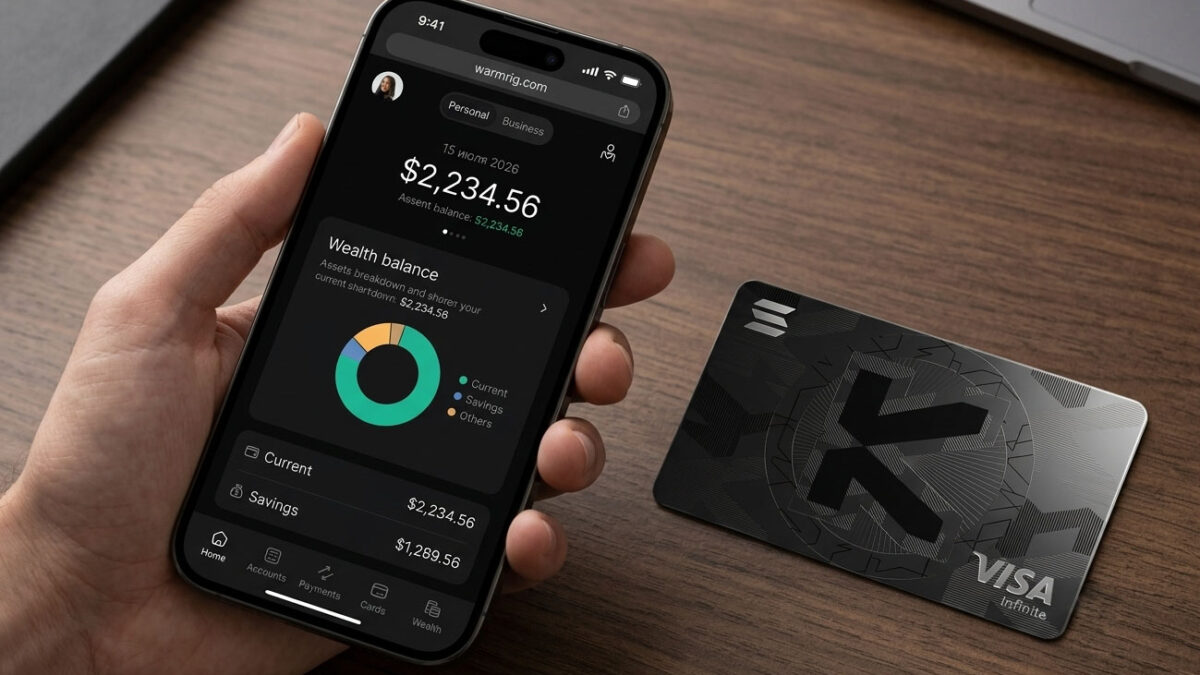














[…] Wise Business Review 2026: The Multi-Currency Account for Affiliates and Media Buyers […]