


 By
By KAST Review 2026: The Stablecoin Card Built
If you run paid traffic or push affiliate offers, the hardest part is rarely the campaign. It’s the money plumbing around it — getting paid by networks on their schedule, in their currency, on their rails, and then moving that money where you actually need it without a bank freezing the transfer or a payout sitting in limbo for a week.
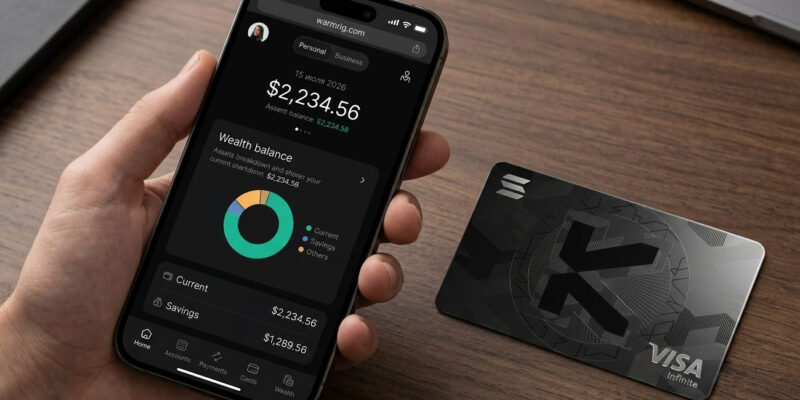
KAST is a stablecoin-powered financial platform that tries to collapse that whole mess into one app: a virtual US account, a European IBAN, on-chain USDC/USDT rails, and a Visa card that spends at 150 million-plus merchants. It’s usually reviewed as a tool for digital nomads. This review looks at it from the only angle that matters here — as a payout hub and spending layer for people in performance marketing — and it’s honest about where it fits and where it doesn’t.
Disclaimer: This is an independent, informational review, not financial, tax, or legal advice. KAST is not a bank, and balances are not FDIC-insured. Rates, fees, and tier prices change often — always verify current terms at kast.xyz before acting.
Quick verdict
KAST is a strong receive-and-spend tool and a weak ad-account-funding tool. As a place to collect network payouts across US ACH, EU SEPA, and crypto, hold them in dollars, and spend on a Visa card with real USD cashback, it’s one of the most complete options in 2026. As a way to fund and rotate many Facebook/TikTok/Google ad accounts, it isn’t built for that — it’s a single debit card on a stablecoin balance, not a virtual-card (VCC) provider. Treat it as your money destination and treasury, not your ad-buying stack.
| What it is | Stablecoin fintech (not a bank), founded July 2024 |
| Backing | $80M Series A at a $600M valuation (QED Investors, Left Lane Capital, Peak XV, DST Global) |
| Scale | 1M+ users, ~$5B annualized transaction volume |
| Accounts | Virtual US (ACH routing) + EU (SEPA IBAN), plus on-chain USDC/USDT |
| Card | Visa debit, virtual + physical, 150M+ merchants, Apple Pay / Google Pay |
| Cashback | Real USD (not points): 1–2% Standard, 2% Premium, up to 3% Private |
| Yield | Up to 7% APY on idle balances (variable, via Gauntlet vaults) |
| The catch | FX fees up to ~1.75% on non-USD spend on lower tiers |
What KAST actually is (in plain terms)
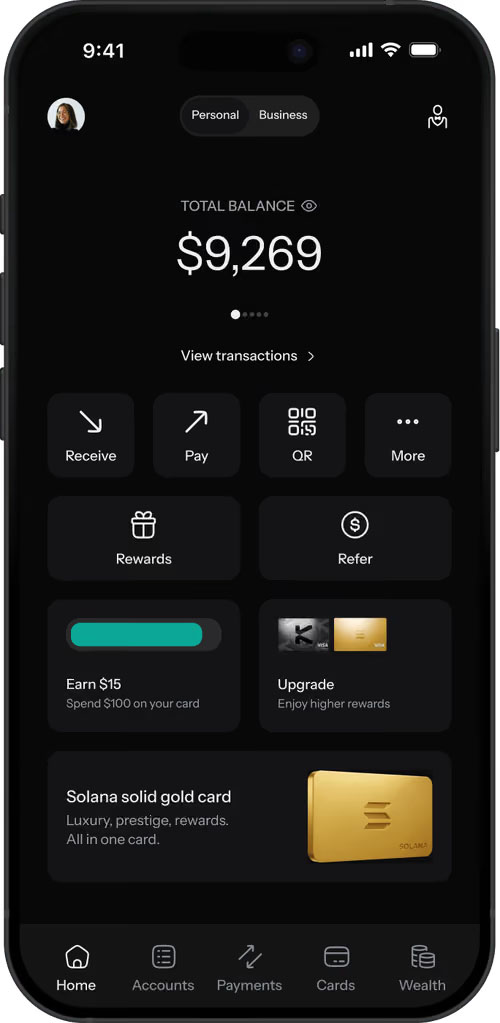
KAST is a fintech company, not a bank. It sits on top of licensed banking and custody partners and uses stablecoins — mainly USDC and USDT, primarily on Solana — as the settlement layer underneath a product that behaves like an ordinary account and card.
The founder credibility is real and worth noting because it’s the kind of trust signal that separates a serious platform from a fly-by-night crypto card. KAST was founded in July 2024 by Raagulan Pathy, a former Circle executive who spent years inside the company that issues USDC. The team has since pulled hires from Stripe, Revolut, Binance, Circle, Airwallex, Phantom, and Wise, and the company raised $80 million in a Series A at a $600 million valuation in early 2026, co-led by QED Investors and Left Lane Capital. For context, QED is one of the most selective fintech investors in the world, so their involvement is a stronger external signal than most consumer crypto cards can point to.
The mechanic that matters: any fiat you receive is auto-converted to stablecoins on arrival. A US client sends an ACH transfer, a network pays your EU IBAN over SEPA, someone sends you USDT on Solana — it all lands as a stablecoin balance you can hold, earn yield on, send on-chain, or spend on the card.
Why this matters for affiliates and media buyers
Forget the “digital nomad receiving a salary” framing. Here’s the same infrastructure translated into performance-marketing reality.
One account for messy payout rails. Affiliate and CPA networks pay however they want — US wire, SEPA, SWIFT, or crypto. Instead of juggling a Payoneer account for one network, a Wise account for another, and a wallet for the crypto ones, KAST gives you US ACH details, an EU IBAN, and on-chain USDC/USDT receiving in a single place. You hand a network whichever set of details fits their system.
Payouts land as dollars, not your local currency. For anyone earning in USD/EUR but living somewhere with a soft currency or twitchy banks, auto-conversion to USDC means the value doesn’t erode while you decide what to do with it — and it isn’t sitting in a local bank account that might question a large irregular deposit.
Idle float earns instead of sitting dead. Between reinvesting into campaigns, a USDC balance can sit in KAST Earn at a variable rate (advertised up to 7% APY). Useful, with a caveat covered below.
Spend directly on the tools you already pay for. Antidetect subscriptions, proxy plans, hosting, SaaS — a Visa card that pulls from your USDC balance with real USD cashback turns your operating spend into a small rebate instead of a pure cost.
That’s the honest fit: KAST is where money arrives, waits, and gets spent — not where campaigns get funded.
Receiving payouts: the core use case
This is the part worth setting up carefully, because it’s the reason to open an account at all.
US ACH (for US-based networks and clients). After KYC, you get an account number and routing number via KAST’s US banking partner. To a US payer it looks like a normal domestic bank transfer — they don’t need to know a stablecoin is involved. Funds typically arrive in one to two business days and land as USDC.
EU SEPA IBAN (for European networks and clients). You also get a real IBAN for receiving euro transfers. With SEPA Instant now standard across the eurozone, transfers can arrive in seconds to minutes when the sender’s bank supports it, or next business day otherwise.
On-chain USDC/USDT (for crypto-paying networks). Networks that pay in stablecoins send straight to your KAST wallet address. Receiving crypto is free on KAST’s side; you only ever pay the network fee when you later withdraw — fractions of a cent on Solana, more on Ethereum. Solana is the fast, cheap default.
The practical win is consolidation. One KYC, one dashboard, three rails — instead of maintaining separate accounts per payout method and reconciling across all of them.
The card and the cashback (and the fee nobody advertises)
KAST issues Visa debit cards, virtual and physical, accepted at 150 million-plus merchants with full Apple Pay and Google Pay support. The cashback is genuinely one of the better structures on the market because it pays real, spendable USD credited to your balance — not points, not a token, not a redemption catalog. There’s no category juggling and no monthly cap on the cashback itself.
The rates scale with tier: roughly 1–2% on Standard, 2% plus KAST Points on Premium, and up to 3% plus higher Points on Private.
Now the part most reviews bury: FX fees. When you spend in a currency other than USD, KAST charges a foreign-exchange fee that runs up to about 1.75% on lower tiers (lower on higher tiers, roughly 0.5%–1.75% across the range). That single line item is the most important cost to understand before you pick a tier.
Do the math for your own spend. If most of what you buy is priced in USD — a lot of marketing SaaS, proxies, and ad tooling is — the economics are clean: minimal FX drag, plus 1–3% back. But if you spend heavily in euros or your local currency, that 1.75% can quietly eat most of your cashback. KAST is optimized for people who earn and spend in dollars and use it as their primary USD account, not as a travel card for constant currency conversion.
KAST Earn: yield on idle balances
Instead of withdrawing every payout immediately, you can leave USDC in KAST Earn and collect a variable yield, advertised up to 7% APY, generated through risk-adjusted vaults (including a treasury-backed option) run in partnership with Gauntlet, a well-known DeFi risk-modeling firm. There’s no lock-up; you can pull funds any time.
The honest framing: this is DeFi yield, not a bank deposit. 7% is competitive, but understand what backs a given vault before parking a serious balance. Treasury-backed strategies sit at the conservative end; the higher advertised rates carry more smart-contract and strategy risk. For an affiliate’s working float, this is fine for short-to-medium parking — just don’t treat it as a savings account with guarantees, because it isn’t one.
Membership tiers and the honest math
KAST runs three tiers, and picking one on vibes is how you overpay.
| Standard | Premium | Private | |
|---|---|---|---|
| Annual cost | Free / low | ~$1,000 | ~$10,000 |
| Cashback (USD) | 1–2% | 2% + Points | Up to 3% + Points |
| Card | Basic Visa | Visa Infinite + travel perks | Plated gold + extra cards |
| FX fee (non-USD) | Up to ~1.75% | Reduced | Lowest |
| Realistic fit | Testing the platform | ~$50K+/yr card spend | ~$300K+/yr card spend |
Run the numbers before upgrading. Going Standard → Premium buys you roughly an extra 1% cashback; at $50,000 of annual card spend that’s about $500, which doesn’t cover the $1,000 tier on cashback alone — you’re paying for the reduced FX fee, higher limits, and Visa Infinite perks on top. Private only starts to make sense on cashback math at very high volume (around $10,000/month in card spend returns ~$3,600/year at 3%). For most people starting out, Standard is the correct tier until real spend volume justifies moving up.
Fees at a glance
| Action | Cost |
|---|---|
| Receive crypto (USDC/USDT) | Free |
| Receive via ACH / SEPA | Free |
| Spend in USD | No FX fee |
| Spend in non-USD | ~0.5%–1.75% FX (tier-dependent) |
| Crypto withdrawal | Network fee only (Solana ~$0.001; Ethereum higher) |
| ATM / physical card | Withdrawal and shipping fees apply |
The pattern: KAST is cheap-to-free on the receiving side and on crypto movement, and its real cost shows up on non-USD card spend. Structure your usage around that and it’s inexpensive.
KYC, AML, and keeping your account alive
This section matters more for affiliates than for the average user, because payout accounts are exactly the kind of accounts that get flagged. Large, irregular deposits from multiple sources are a normal week for a media buyer and a textbook AML trigger for a compliance system.
KAST runs standard verification — passport plus a live selfie — and ongoing monitoring including sanctions and PEP screening and transaction analysis. What tends to trigger a document request: a sudden jump in volume, many inbound transfers from different sources, or funds routed through mixers or sketchy exchanges.
Protect yourself the boring way. Keep invoices and network statements for your payouts from day one, so that when a source-of-funds request lands you can answer it in minutes instead of scrambling. Respond promptly and honestly — ignoring a request is how accounts get frozen, and dishonesty is how they get permanently closed. And critically: because it’s not a bank and not FDIC-insured, don’t warehouse your whole float here. Keep working balances in KAST and move larger reserves out to a bank or cold storage.
Can you fund ad accounts with it? Read this first
Short answer: not really, and not at scale. KAST is a single debit card tied to a stablecoin balance. Running paid traffic properly means many card numbers across many ad accounts to isolate risk — that’s what dedicated virtual-card (VCC) providers exist for. KAST doesn’t fill that role, and ad platforms are picky about card BINs and prepaid/fintech ranges anyway.
If you’re curious whether your KAST card clears on a given platform, test tiny on one account before relying on it — a small top-up, watch whether it holds. But don’t build your ad-funding stack on it. Use KAST for the money side — receiving, holding, spending on tools — and a proper VCC solution for feeding ad accounts. They’re different jobs.
The risks, stated plainly
Every fintech has risk. KAST’s are specific and worth naming.
Not a bank, not insured. Your balance is a stablecoin claim held through custody partners, not a protected deposit. If KAST as a company fails, there’s no FDIC backstop — you’re relying on the custodians.
Custody risk. Funds sit with third parties (Fireblocks, BitGo). These are top-tier institutional custodians, but “someone else holds it” is always a risk vector.
Stablecoin risk. USDC and USDT are issuer obligations. A depeg event (as USDC briefly saw in 2023) can temporarily knock a balance off its dollar value.
Platform and track-record risk. KAST launched in 2024. Its App Store ratings are decent (~4.0 iOS, ~3.7 Google Play), but its Trustpilot sits around 3.2, and the recurring complaints are the ones that matter most for a money account: KYC delays, occasional declines, and slow support during account holds. For a primary payout account, any frozen-funds episode is disproportionately painful.
Competition closing in. The cashback-and-yield edge that made KAST stand out is being chased by better-distributed players — Revolut is expanding stablecoin features, and the likes of Coinbase and SoFi are moving in with far larger existing user bases. The product is strong today; whether its differentiation holds through late 2026 is a fair question.
Mitigation is common sense: don’t keep everything on one platform, move large reserves out regularly, keep clean transaction records, and use 2FA via an authenticator app rather than SMS.
KAST vs. the tools you’re already using
For a performance marketer, the real comparison isn’t other crypto cards — it’s the payout and money-movement tools you already run.
vs. Payoneer. Payoneer is widely accepted by networks and straightforward for receiving, but you’re locked into fiat, withdrawals to your local bank take time, and there’s no crypto leg and no yield. KAST adds on-chain rails, dollar-denominated holding, and cashback — at the cost of being a younger, non-bank platform.
vs. Wise. Wise is the better pure fiat option: cheaper, more established, better for classic cross-border transfers and holding many currencies. But Wise doesn’t auto-convert to stablecoins, doesn’t move on-chain, and doesn’t pay meaningful cashback. Many people run both — Wise for fiat, KAST for the crypto-plus-spend side.
vs. a plain crypto wallet + exchange. If networks pay you only in USDT and you only ever off-ramp, a wallet works. KAST’s advantage is turning that stablecoin balance into something you can spend on a Visa card and hold with yield, plus the fiat ACH/SEPA rails a bare wallet can’t give you.
The realistic setup for most people in this space: KAST as the receive-hold-spend hub, Wise or Payoneer as the fiat backup, a proper VCC for ad funding, and cold storage for real reserves. No single tool does all of it well.
FAQ
Is KAST a bank? No. KAST is a fintech company operating through licensed banking and custody partners. Balances are stablecoin claims, not bank deposits, and are not FDIC-insured — even though the underlying US banking partner is itself a regulated bank.
How does KAST make receiving affiliate payouts easier? It consolidates three payout rails — US ACH, EU SEPA IBAN, and on-chain USDC/USDT — into one KYC’d account. You give each network whichever details fit their payout system, and everything lands as a single dollar-denominated balance instead of scattered across separate accounts.
What are KAST’s real fees? Receiving (crypto, ACH, SEPA) is free, and USD spending has no FX fee. The meaningful cost is the FX fee on non-USD card spending — up to about 1.75% on lower tiers. Crypto withdrawals cost only the network fee.
What’s the catch with the up-to-7% yield? It’s variable DeFi yield through Gauntlet-run vaults, not a guaranteed bank rate. Conservative treasury-backed strategies sit lower; the top advertised rates carry more risk. No lock-up, but understand what backs a vault before allocating a large balance.
Can I fund Facebook or TikTok ad accounts with a KAST card? Not reliably, and not at scale. It’s one debit card on a stablecoin balance, not a multi-card VCC service. Test small on a single account if you want, but use a dedicated virtual-card provider for actual ad-account funding.
Which tier should I start on? Standard. The $1,000 Premium and $10,000 Private tiers only pay off at high card-spend volume, and you can’t evaluate that without using the platform first. Upgrade later if your numbers justify it.
Is my money safe on KAST? Safe enough for a working balance if you understand it’s a non-bank platform with custody, stablecoin, and young-company risk. Don’t hold reserves you can’t afford to have temporarily locked during an account review. Keep large amounts in a bank or cold storage.
Bottom line
For anyone earning from paid traffic or affiliate offers, KAST solves a real and annoying problem: it turns a tangle of payout rails into one dollar account you can hold, earn on, and spend from with a Visa card and genuine USD cashback. The founder pedigree, institutional backing, and Solana-native speed are all real advantages.
Just use it for what it’s good at. It’s a payout hub and treasury, not an ad-funding stack — keep a VCC for that. Watch the non-USD FX fee, start on Standard, keep clean records for the AML requests that will come with irregular payouts, and don’t warehouse your whole float on a platform that isn’t a bank. Fit it into that lane and it earns its place in a serious money-movement setup.
Written for WarmRig — tested tools and infrastructure for traffic arbitrage and performance marketing. Independent, not sponsored.
Product Review
Thank you
Your Review is appreciated

















[…] […]
[…] […]